
Skip to content
Hawthorne Aviation
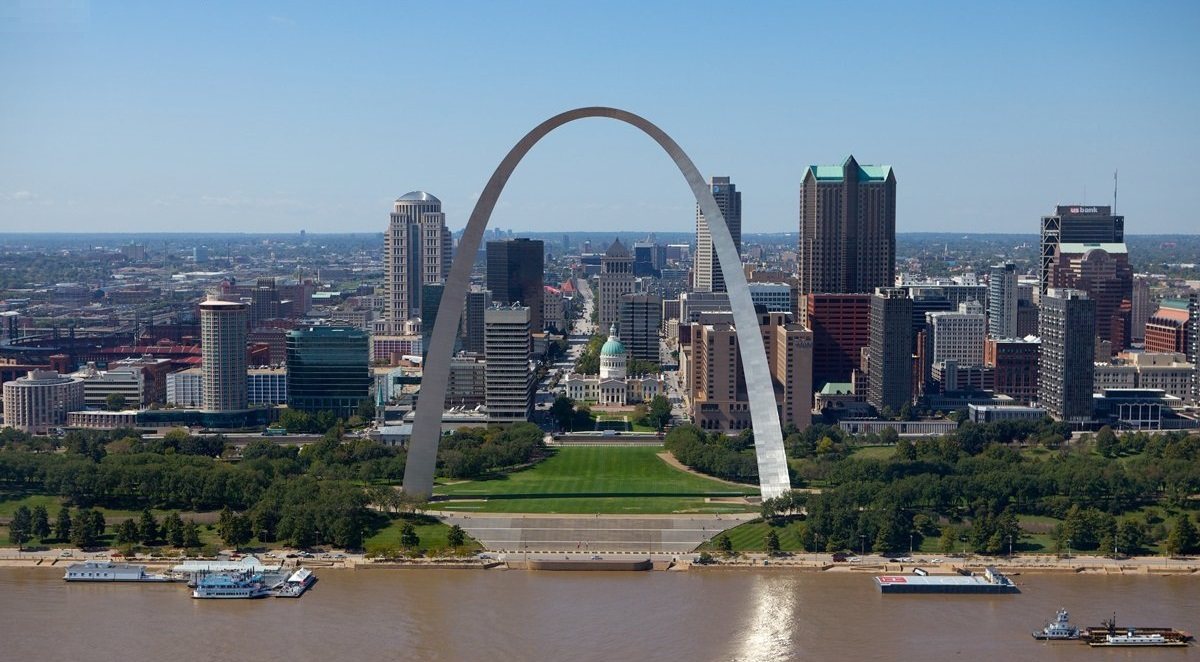
The Gateway Arch is a 630-foot (192 m) monument in St. Louis in the U.S. state of Missouri. Clad in stainless steel and built in the form of an inverted, weighted catenary arch, it is the world's tallest arch, the tallest monument in the Western Hemisphere, and Missouri's tallest accessible building. Built as a monument to the westward expansion of the United States, it is the centerpiece of the Jefferson National Expansion Memorial and has become an internationally famous symbol of St. Louis. The arch sits at the site of St. Louis' founding on the west bank of the Mississippi River. The Gateway Arch was designed by Finnish-American architect Eero Saarinen and German-American structural engineer Hannskarl Bandel in 1947. Construction began on February 12, 1963, and was completed on October 28, 1965, for $13 million (equivalent to $180 million in 2013). The monument opened to the public on June 10, 1967. Physical characteristics Both the width and height of the arch are 630 feet (192 m). The arch is the tallest memorial in the United States and the tallest stainless steel monument in the world. The cross-sections of the arch's legs are equilateral triangles, narrowing from 54 feet (16 m) per side at the bases to 17 feet (5.2 m) per side at the top. Each wall consists of a stainless steel skin covering a sandwich of two carbon-steel walls with reinforced concrete in the middle from ground level to 300 feet (91 m), with carbon steel to the peak. The arch is hollow to accommodate an unique tram system that takes visitors to an observation deck at the top. The structural load is supported by a stressed-skin design. Each leg is embedded in 25,980 short tons (23,570 t) of concrete 44 feet (13 m) thick and 60 feet (18 m) deep. Twenty feet (6.1 m) of the foundation is in bedrock. The arch is resistant to earthquakes and is designed to sway up to 9 inches (23 cm) in either direction while withstanding winds up to 150 miles per hour (240 km/h). The structure weighs 42,878 short tons (38,898 t), of which concrete composes 25,980 short tons (23,570 t); structural steel interior, 2,157 short tons (1,957 t); and the stainless steel panels that cover the exterior of the arch, 886 short tons (804 t). This amount of stainless steel is the most used in any one project in history.The base of each leg at ground level had to have an engineering tolerance of 1⁄64 inch (0.40 mm) or the two legs would not meet at the top Design competition (1945–1948) In November 1944, Smith discussed with Newton Drury, the National Park Service Director, the design of the memorial, asserting that the memorial should be "transcending in spiritual and aesthetic values," best represented by "one central feature: a single shaft, a building, an arch, or something else that would symbolize American culture and civilization." The idea of an architectural competition to determine the design of the memorial was favored at the inaugural meeting of the Jefferson National Expansion Memorial Association (JNEMA), which planned to award cash for the best design. In January 1945, the JNEMA officially announced a two-stage design competition that would cost $225,000 to organize. Smith and the JNEMA struggled to raise the funds, garnering only a third of the required total by June 1945. Then mayor Aloys Kaufmann feared that the lack of public support would lead officials to abandon hope in the project. The passage of a year brought little success, and Smith frantically underwrote the remaining $40,000 in May 1946. By June, Smith found others to assume portions of his underwriting, with $17,000 remaining under his sponsorship. In February 1947, the underwriters were compensated, and the fund stood over $231,199. Saarinen's team included himself as designer, J. Henderson Barr as associate designer, and Dan Kiley as landscape architect, as well as Lily Swann Saarinen as sculptor and Alexander Girard as painter. In the first stage of the competition, Swedish sculptor Carl Milles advised Saarinen to change the bases of each leg to triangles instead of squares. Saarinen said that he "worked at first with mathematical shapes, but finally adjusted it according to the eye." At submission, Saarinen's plans laid out the arch at 509 feet (155 m) tall and 592 feet (180 m) wide from center to center of the triangle bases. On September 1, 1947, submissions for the first stage were received by the jury. The submissions were labeled by numbers only, and the names of the designers were kept anonymous. Upon four days of deliberation, the jury narrowed down the 172 submissions, which included Saarinen's father Eliel, to five finalists, and announced the corresponding numbers to the media on September 27. Saarinen's design (#144) was among the finalists, and comments written on it included "relevant, beautiful, perhaps inspired would be the right word" (Roland Wank) and "an abstract form peculiarly happy in its symbolism" (Charles Nagel). Hare questioned the feasibility of the design but appreciated the thoughtfulness behind it. Local St. Louis architect Harris Armstrong was also one of the finalists. The secretary who sent out the telegrams informing finalists of their advancement mistakenly sent one to Eliel rather than Eero. The family celebrated with champagne, and two hours later, a competition representative called to correct the mistake. Eliel 'broke out a second bottle of champagne' to toast his son. Public access In April 1965, three million tourists were expected to visit the arch after completion; 619,763 tourists visited the top of the arch in its first year open. On January 15, 1969, a visitor from Nashville, Tennessee became the one-millionth person to reach the observation area; the ten-millionth person ascended to the top on August 24, 1979. In 1974, the arch was ranked fourth on a list of "most-visited man-made attraction". The Gateway Arch is one of the most visited tourist attractions in the world with over four million visitors annually, of which around one million travel to the top. The arch was listed as a National Historic Landmark on June 2, 1987, and is also listed on the National Register of Historic Places. Visitor center The underground visitor center for the arch was designed as part of the National Park Service's Mission 66 program. The 70,000-square-foot (6,500 m2) center is located directly below the arch, between its legs. Although construction on the visitor center began at the same time as construction for the arch itself, it did not conclude until 1976 because of insufficient funding; however, the center opened with several exhibits on June 10, 1967. Access to the visitor center is provided through ramps adjacent to each leg of the arch. Observation area Near the top of the Arch, passengers exit the tram compartment and climb a slight grade to enter the observation area. This arched deck, 65 feet (20 m) long and 7 feet (2.1 m) wide, can hold about 160 people, four trams' worth. Sixteen windows per side, each measuring 7 by 27 inches (180 mm × 690 mm), offer views up to 30 miles (48 km): to the east across the Mississippi River and southern Illinois with its prominent Mississippian culture mounds at Cahokia Mounds, and to the west over the city of St. Louis and St. Louis County beyond. Symbolism and culture Built as a monument to the westward expansion of the United States, the arch typifies "the pioneer spirit of the men and women who won the West, and those of a latter day to strive on other frontiers." The arch has become the iconic image of St. Louis, appearing in many parts of city culture. In 1968, three years after the monument's opening, the St. Louis phone directory contained 65 corporations with "Gateway" in their title and 17 with "Arch". Arches also appeared over gas stations and drive-in restaurants. In the 1970s, a local sports team adopted the name "Fighting Arches"; St. Louis Community College would later (when consolidating all athletic programs under a single banner) name its sports teams "Archers". Robert S. Chandler, an NPS superintendent, said, "Most [visitors] are awed by the size and scale of the Arch, but they don't understand what it's all about ... Too many people see it as just a symbol of the city of St. Louis." The arch has also appeared as a symbol of the State of Missouri. On November 22, 2002, at the Missouri State Capitol, Lori Hauser Holden, wife of then Governor Bob Holden uncovered the winning design for a Missouri coin design competition as part of the Fifty States Commemorative Coin Program. Designed by watercolorist Paul Jackson, the coin portrays "three members of the Lewis and Clark expedition paddling a boat on the Missouri River upon returning to St. Louis" with the arch as the backdrop. Holden said that the arch was "a symbol for the entire state ... Four million visitors each year see the Arch. [The coin] will help make it even more loved worldwide." A special license plate designed by Arnold Worldwide featured the arch, labeled with "Gateway to the West." Profits earned from selling the plates would fund the museum and other educational components of the arch.

St. Louis, MO

Private Jet Charter in St. Louis, MO

Photo: Sam valadi · CC BY 2.0

A private flight to St. Louis, Missouri, can be planned around west-county business and metropolitan visits. Hawthorne Aviation arranges charter through certificated air carriers, comparing the airport, available aircraft and schedule against your complete itinerary rather than just the city name.

Spirit of St Louis Airport (SUS) is a candidate gateway in St Louis. Give your advisor the address of your final stop in St. Louis: the closest airport on a map is not always the most suitable one for the aircraft, weather or ground journey.

Airports for private flights in St. Louis

  • Spirit of St Louis Airport (SUS) — Spirit of St Louis Airport in St Louis. The operating carrier must confirm runway performance, current airport access and services for your specific flight.

Before a St. Louis charter is confirmed, we coordinate the passenger meeting location, handling availability and ground pickup at SUS with the carrier. Do not go to an airline terminal unless your confirmed itinerary specifically directs you there. Smaller airports may require advance arrangements or a different gateway.

Recommended aircraft from St. Louis

For St. Louis, start with the length of the flight and your passenger and baggage requirements. Turboprops and light jets can suit regional trips; midsize and super-midsize aircraft offer options for longer legs. For west-county business and metropolitan visits, mention special equipment and any fixed arrival deadline. Category alone does not establish suitability for SUS.

  • Turboprops — 6–8 passengers; short regional hops and shorter or unpaved-adjacent runways.
  • Light Jets — 5–7 passengers; two- to three-hour trips for small groups with modest luggage.
  • Midsize Jets — 7–9 passengers; east coast to florida nonstops with room to stand.
  • Super-Midsize Jets — 8–10 passengers; coast-to-coast nonstops and larger luggage loads.

Flight planning in St. Louis

  • Local itinerary: for west-county business and metropolitan visits, share each stop's address and the time you need to be there. Include the drive from SUS, not just the flight, when setting your arrival target.
  • Seasonal planning: winter weather and low visibility can affect flight timing and ground transfers. Ask the operator about de-icing and a suitable alternate airport when your arrival time is critical.
  • Airport access: Spirit of St Louis Airport (SUS) is a planning option, not guaranteed access. The carrier checks runway conditions, notices, operating hours and aircraft performance before committing to the flight.
  • Return schedule: tell us whether your St. Louis visit is a same-day round trip, a longer stay or part of a multi-city itinerary. Keeping an aircraft nearby versus repositioning it can change the overall quote.

Charter pricing guidance

Charter is priced for the whole aircraft based on flight time, aircraft category, repositioning, and fees. We provide a firm quote once we confirm available aircraft for your dates. See what affects charter cost.

Example flights from St. Louis

Illustrative one-way estimates for six passengers in a super-midsize aircraft, including approximate federal excise tax. These are not live offers; repositioning, airport charges and other fees may be additional.

DestinationFlight timePlanning range
Teterboro, NJ2h 05m$15,800–$23,800
West Palm Beach, FL2h 25m$17,900–$26,900
Wheeling, IL0h 50m$11,300–$16,900
Los Angeles, CA3h 30m$26,200–$39,200

Booking your St. Louis charter

Share your departure airport, travel dates, passengers and luggage with a Hawthorne advisor. We compare suitable aircraft from certificated carriers, explain the quote and confirm the private-terminal meeting point. Golf bags, skis, pets and ground transportation should be requested before the aircraft is selected.

Coordinate ground transport and cabin requests, compare aircraft categories, or explore empty-leg flight options. Empty-leg availability is variable and may not match a fixed itinerary.

St. Louis private jet charter FAQs

Airport references

Airport information is for planning; the operating carrier confirms current access, services and aircraft suitability.

Personal charter support

Request a St. Louis charter quote

Share your trip details and an advisor will compare aircraft from certificated operators and follow up with options. There is no obligation to book.

Prefer to talk? (877) 709-5387

CallRequest a Quote